Software-defined vehicles · Marine

Crooze EZ28: a software-defined boat

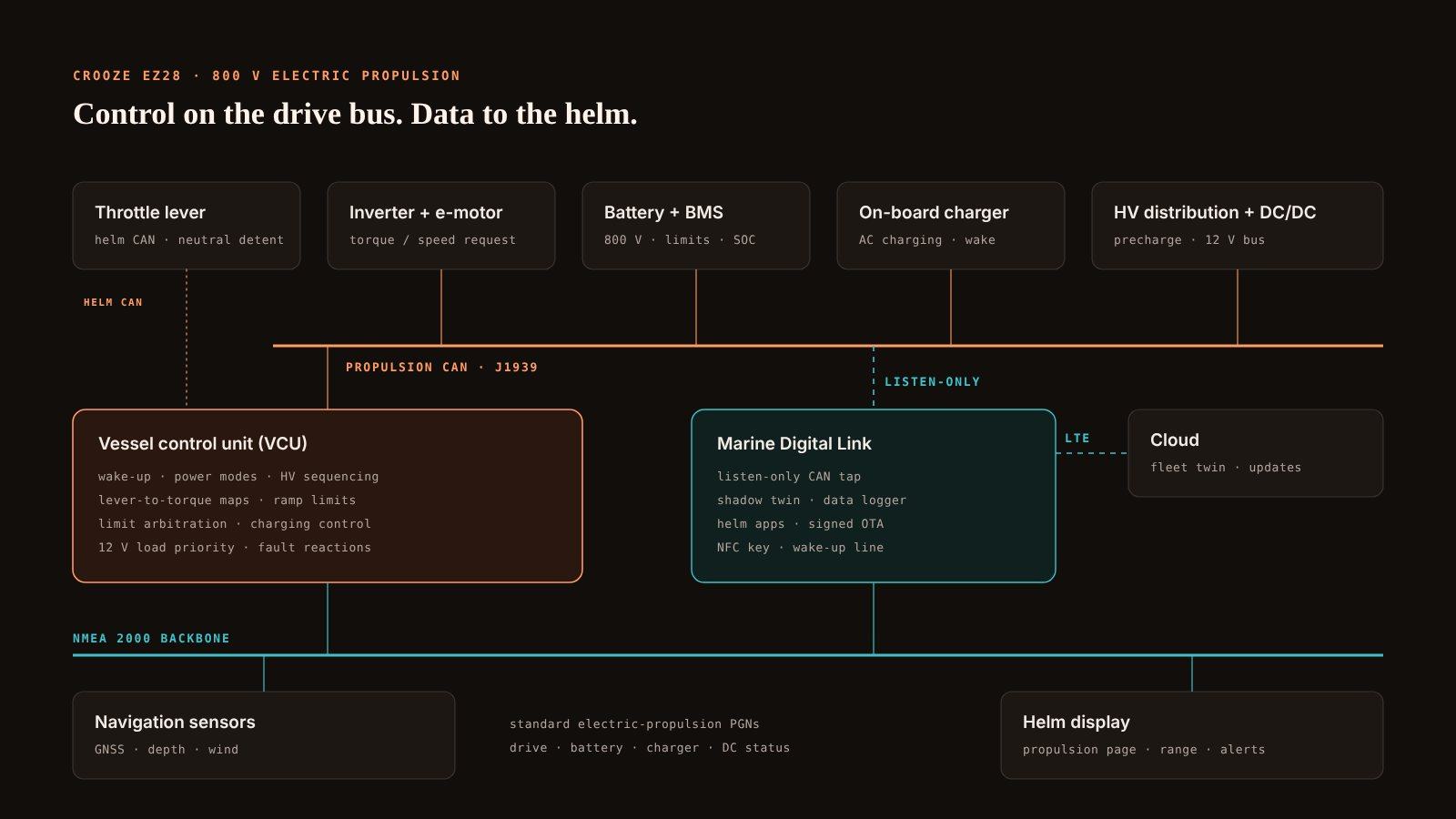
Crooze Yachts is building the EZ28, an 800 V electric yacht designed as a software-defined boat. Lavaflows is engineering its control system: one vessel control unit on three networks, a gateway that listens to the drive and serves the helm, and a software platform that updates over the air.

800 V propulsionCAN / J1939NMEA 2000Embedded controlEmbedded LinuxRaspberry Pi 5Signed OTA updatesDigital twin
Crooze EZ28 propulsion and helm architecture

Problem

An electric yacht is several suppliers' components on one bus: inverter and motor, battery and battery management, on-board charger, high-voltage distribution, DC/DC converter, chiller, and throttle lever. Eighteen components in all, each speaking its own protocol. None of them knows how to start the boat, limit power when the pack is cold, stop it driving away on shore power, or explain a fault to the skipper.

Crooze also wanted a boat that keeps getting better after delivery: new helm functions, better range estimates, and service insight from real data. That needs a way to get data off the boat and software onto it that can never touch the propulsion system.

Solution

We treated the boat as a software-defined vehicle: what it does is decided in software on two computers that talk over defined networks, and the two are kept apart on purpose.

  • The control domain. One vessel control unit (VCU) on three CAN networks: propulsion (J1939), helm, and NMEA 2000. Its software is built as nine modules, from the power-mode manager and high-voltage sequencer to the torque manager, limit arbiter, charge manager, thermal manager, and safety monitor. It sequences high voltage, arbitrates every limit the battery and inverter impose, and is the only node allowed to decide that the boat stops. It starts from an interface control document and CAN signal database agreed with the suppliers.
  • The experience domain. The Marine Digital Link, a sealed gateway running embedded Linux with containerised applications. It listens to the propulsion bus in hardware listen-only mode, logs it at full rate, runs a shadow digital twin, serves range, charging, and drive-health views to the helm display, and reads the NFC key that wakes the boat.
  • The update path. Signed software images delivered over the air, staged on an A/B partition and rolled back if they fail. Drive and battery data also reach the helm as standard NMEA 2000 electric-propulsion messages, so any compatible display can show them.

The rule throughout: the twin and the helm applications advise, the control unit decides, and nothing from the cloud or the vessel network reaches the torque path. The same architecture, control unit, and software are meant to stay the same when the motor, battery, or drive changes. Read more on the project page.

Outcome

Delivered so far

  • System architecture: eighteen components on one network, with the power, data, cooling, and mechanical paths defined.
  • The propulsion CAN interface control document, signal database, and the NMEA 2000 message mapping for the helm display, agreed with the component suppliers.
  • Control concept: power modes, high-voltage sequencing, lever arming, charging interlock, and four fault classes (derate, get home, controlled stop, safe stop).
  • Wake-up and start concept: an NFC key tap wakes the boat, and the vessel control unit sequences the drive from there.
  • Marine Digital Link prototype on Raspberry Pi 5 decoding both buses, and a second-generation enclosure design: sealed, fanless, with connectors colour-coded by bus.

Next

  • Bench integration with the real drivetrain components and fault injection against the reaction matrix.
  • On-boat high-voltage commissioning and sea trials.
  • In-water launch of the EZ28 in February 2027, with the helm views and over-the-air updates running on board.
  • After sea trials: drive-health views from the digital twin.

This page will be updated with measured results after sea trials. See how we apply the same approach on land and water in our software-defined vehicles service.