Crooze Yachts · In development

Crooze EZ28: Software-Defined Boat

Eighteen components, one controller. We are building the software that makes the Crooze EZ28 one boat rather than a set of suppliers' parts: the control unit that decides, the networks that carry it, and the platform that updates it.

Software-defined vehicleVessel control unit800 VCAN / J1939NMEA 2000Embedded LinuxSigned OTADigital twin
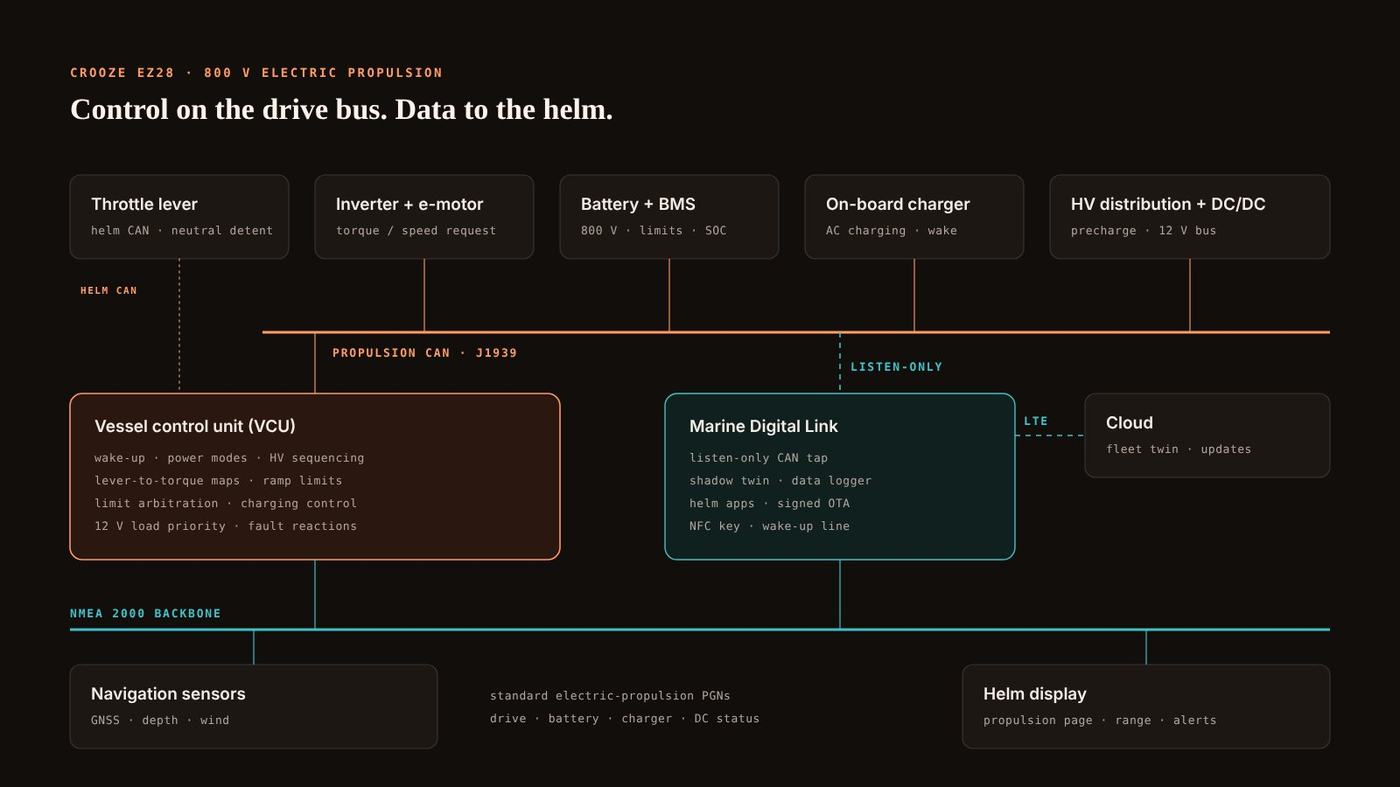
Crooze EZ28 propulsion and helm architecture
One vessel control unit on three networks: propulsion CAN, helm CAN, and NMEA 2000. Data flows out to the helm and the gateway, never back into the drive.
Back to projects

On a software-defined boat, what the vessel does is decided in software, not in the wiring. The motor, inverter, battery, charger, power distribution, DC/DC converter, chiller, and throttle lever each speak their own protocol. One vessel control unit (VCU) turns them into a boat that wakes, drives, charges, and stops safely.

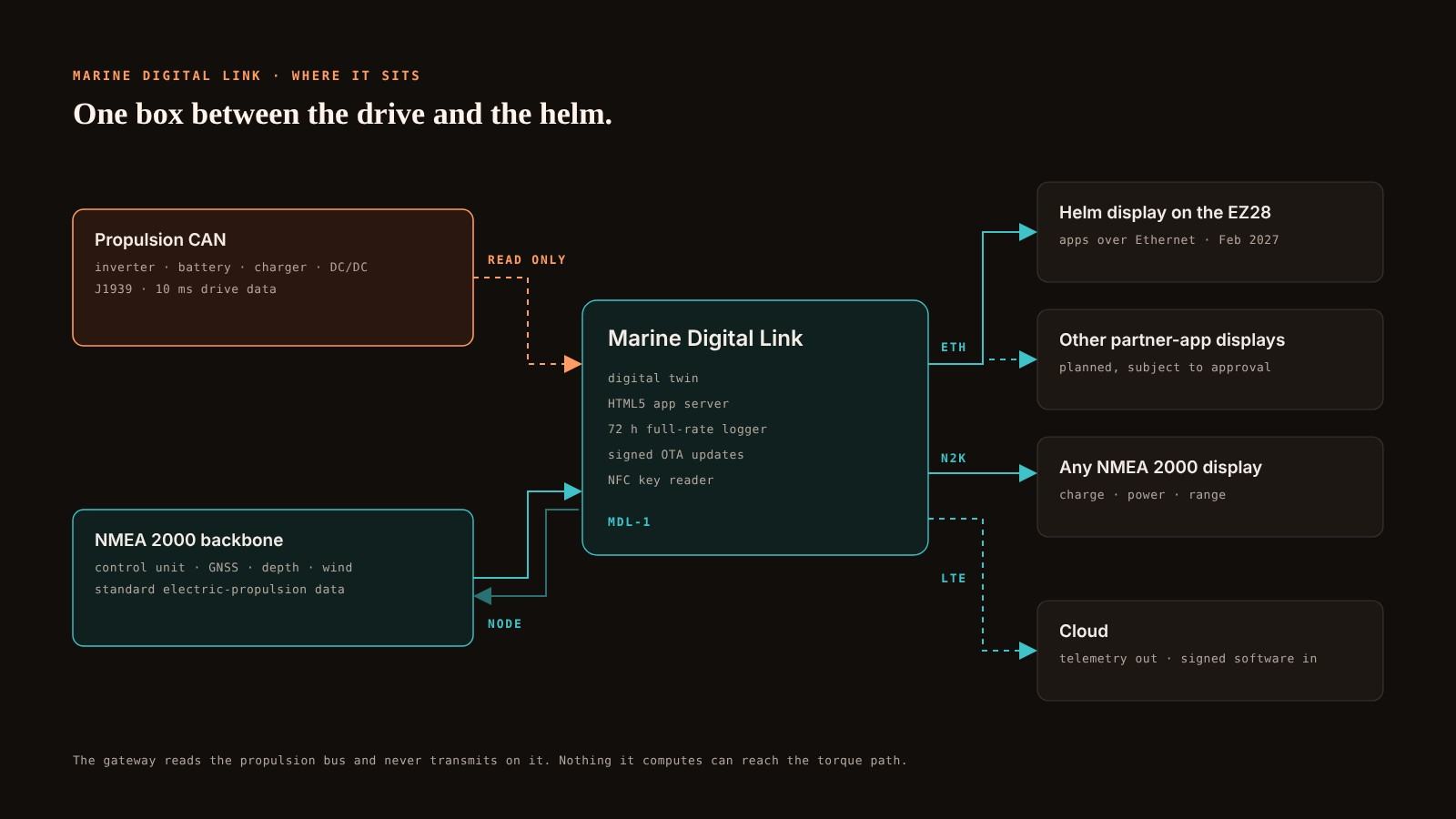
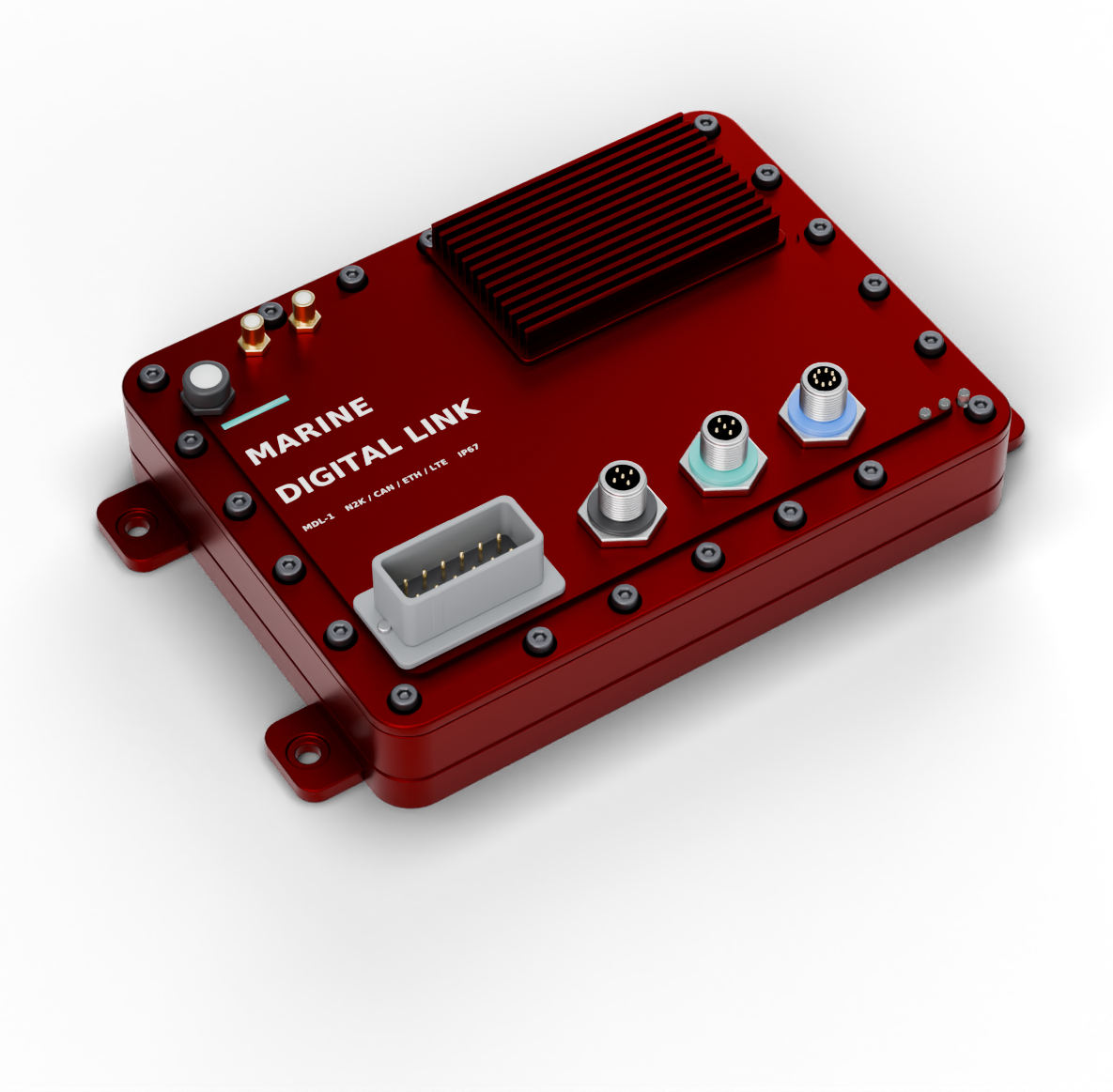
The system is split into two domains on purpose. The control domain decides everything that moves power. The experience domain runs on a separate computer, the Marine Digital Link, which listens to the drive and serves the helm. Data flows from the first to the second and never the other way, so the boat can gain features for years without reopening the safety case.

One controller, three networks

Everything that moves power or reports state hangs off the VCU, and all three of its CAN channels are used: propulsion (J1939, 500 kbit/s) for the high-voltage components, a separate helm bus (250 kbit/s) for the throttle lever, and NMEA 2000 (250 kbit/s) for the helm display and the rest of the vessel. Safety-relevant frames carry end-to-end checksums and counters.

Nine software modules

The control software is built as modules with clear responsibilities: power-mode manager, high-voltage sequencer, torque manager, limit arbiter, charge manager, low-voltage manager, thermal manager, safety monitor, and diagnostic manager. The VCU sequences high voltage, arbitrates every limit the battery and inverter impose, and is the only node allowed to decide that the boat stops.

Rules written in software

The lever is the only thing on the boat that asks for torque, and it has no authority until the drive is armed: neutral must be held with valid frames first. The drive is inhibited for as long as a charging plug is detected. Faults fall into four classes with a defined reaction each: derate, get home, controlled stop, and safe stop.

A platform above the control loop

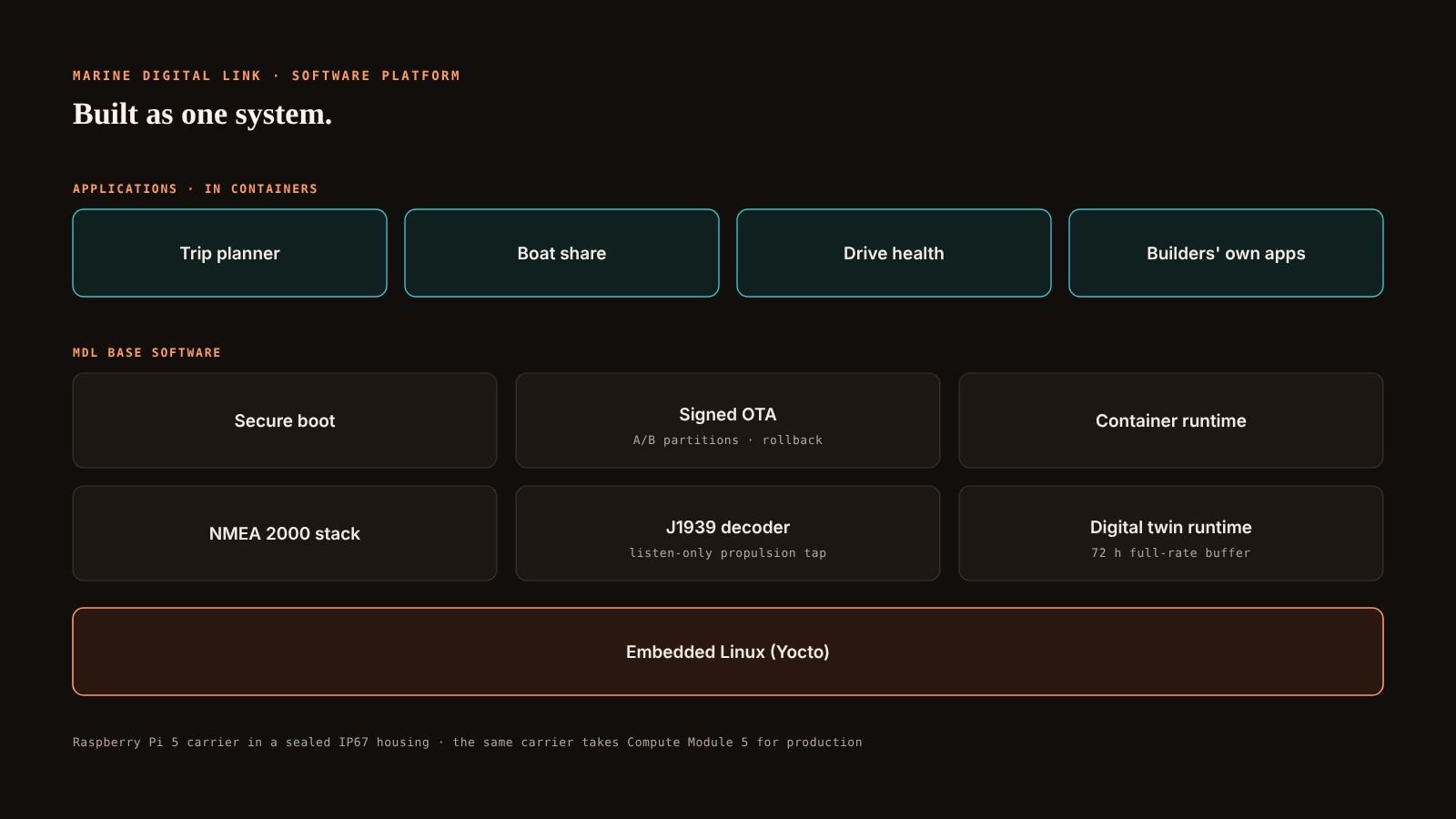
The Marine Digital Link runs embedded Linux with containerised applications, a full-rate data logger with 72 hours on board, and a web server that delivers views to the helm display over Ethernet. Trip planning, boat sharing, and drive-health views are applications on this platform. They can be added or changed without touching the control software.

Built to keep getting better

Software arrives over the air as signed images, staged on an A/B partition and rolled back if it fails. The boat that leaves the yard is a starting point: new helm functions and better estimates arrive as updates, with no visit to the yard and no path from the cloud to the drive.

A digital twin, kept out of the loop

A shadow twin follows the battery, drive, and hull in five steps: sense, tap, mirror, predict, advise. It estimates what nobody measures, such as real range and pack ageing, and flags what has changed. It advises the skipper and the service team; the VCU decides.
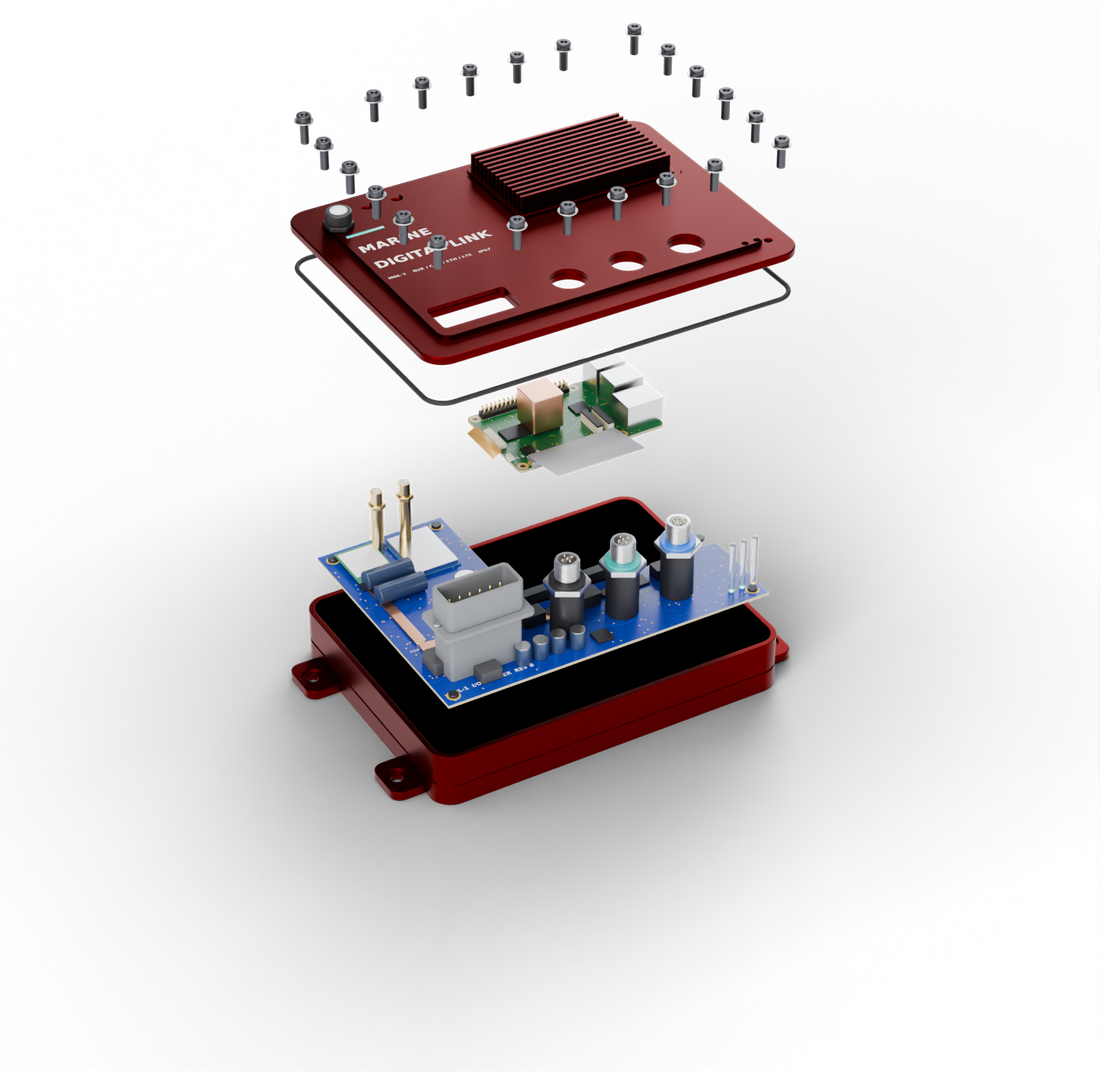
Product structure

What this is shaping into.

The problem, who it is for, where it stands today, and what comes next.

Problem

An electric boat is several suppliers' components on one bus. None of them knows how to start the boat, limit power when the pack is cold, stop it driving away on shore power, or explain a fault to the skipper. That knowledge has to live in one place.

Who it is for

Crooze Yachts for the EZ28. More widely, boat builders and vehicle makers who want one control architecture that stays the same when the motor, battery, or drive changes.

Current status

System architecture, wake-up and start concept, CAN signal database, NMEA 2000 mapping, and interface control document are defined, and the gateway prototype is decoding both buses. Next: bench integration with the real drivetrain and fault injection against the reaction matrix, on-boat high-voltage commissioning, and sea trials ahead of the EZ28 launch in February 2027.

One architecture, several drivetrains

Every configuration shares one architecture. The control unit, wiring logic, and software stay the same when the motor, battery, or drive changes, across 400 V and 800 V systems.

Standard data at the helm

Drive and battery data travel as standard NMEA 2000 electric-propulsion messages, so any compatible display on the backbone can show charge, power, and range without custom integration.

Keyless wake-up

An NFC tap from a phone or key card wakes the boat. The gateway switches the wake-up line; starting the drive stays with the VCU and its own sequence.

Verified before the water

Bench tests with real components, fault injection against the reaction matrix, and test evidence for every function, so work on the boat is confirmation rather than discovery.

What makes a boat software-defined?

Its behaviour lives in software on a small number of computers that talk over defined networks, instead of being fixed by the wiring and each supplier's box. That makes the behaviour testable on a bench, the same across drivetrain options, and improvable after delivery.

Can an app or the cloud affect the drive?

No. The gateway's interface to the propulsion bus is listen-only in hardware, and the cloud returns only signed software for the gateway. Apps and the digital twin advise; the vessel control unit decides.

What happens when something fails?

The VCU classifies the fault and reacts in one of four ways: reduce power, limit the boat to a get-home mode, bring it to a controlled stop, or stop safely at once. Fault codes and the conditions around them are stored for service.

Does the same system fit another boat?

That is the design goal. The architecture, control unit, and software are intended to carry over to other hulls and drivetrains, with the component interfaces and calibration changing rather than the system.

Early access

Building an electric boat or vehicle?

Tell us about your components, networks, and timeline. We work from architecture through bench integration to sea trials.

We use your details to follow up about this project. Read our Privacy notice.